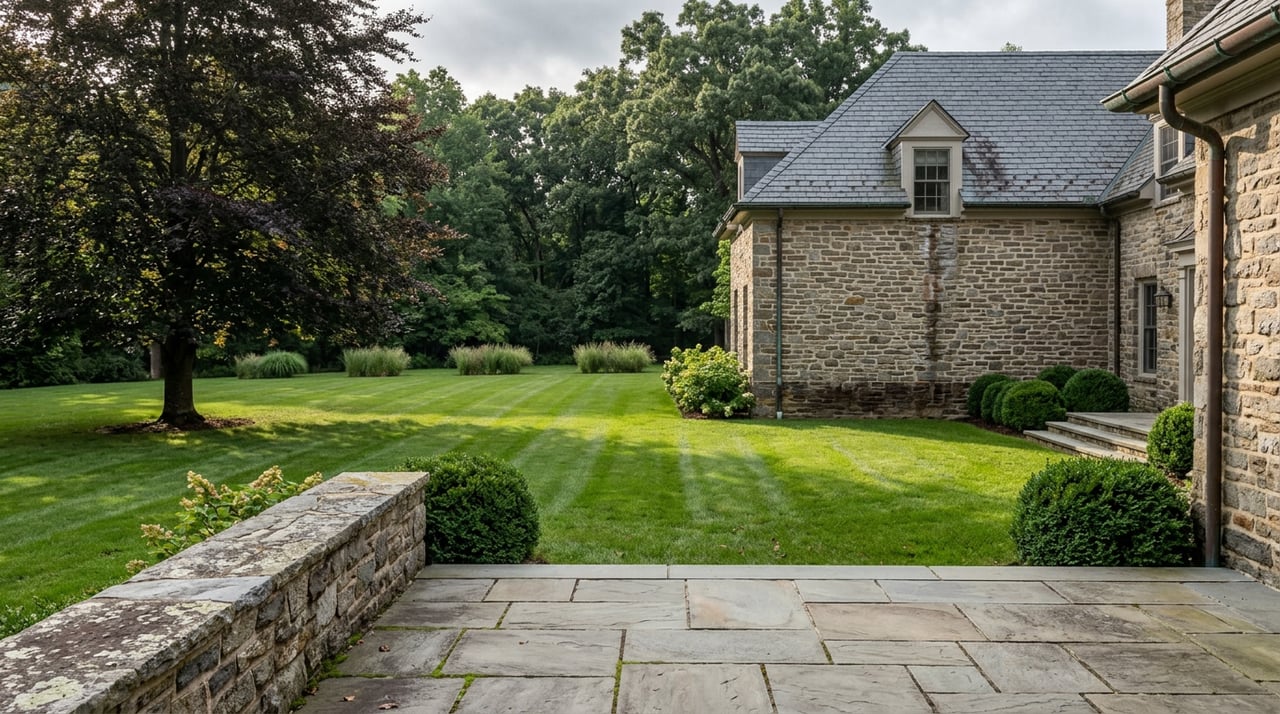
Picture two stone-front houses a half mile apart. One sits on the New Hope side of the Delaware, the other across the bridge in Lambertville. Same river view, same three-bedroom footprint, same asking price of $1.5 million. A buyer walking between them for an afternoon showing could reasonably assume the only real difference is which state issues the mail.
At closing, that assumption falls apart. The seller in Lambertville walks away from roughly $20,000 in state transfer costs. The seller in New Hope, on an identical sale price, faces a total transfer tax bill of $30,000, but splits it with the buyer by local custom, so the seller's actual share lands closer to $15,000. Same river. Same price. A gap of thousands of dollars in who owes what, created not by the market but by a New Jersey law that took effect a little over a year ago.
That gap is the thing worth understanding before anyone compares these two towns on price alone.
The Law That Changed Mid-2025
For two decades, New Jersey's so-called mansion tax worked the same way everywhere: a flat 1 percent fee on any residential sale over $1 million, paid by the buyer at closing, layered on top of the state's standard Realty Transfer Fee, which sellers have paid since 1968.
That changed on June 30, 2025, when Governor Phil Murphy signed legislation shifting the fee, now formally called the Graduated Percent Fee, entirely onto the seller for any deed recorded on or after July 10, 2025. The change didn't stop at reassigning who pays. It also replaced the flat 1 percent with a tiered schedule that climbs as the sale price climbs: 1 percent from $1 million to $2 million, 2 percent from $2 million to $2.5 million, 2.5 percent from $2.5 million to $3 million, 3 percent from $3 million to $3.5 million, and 3.5 percent above that. Each rate applies to the full sale price, not just the amount above the threshold.
A short grace window covered contracts fully signed before July 10, 2025 and recorded by November 15, 2025, which continued under the previous buyer-paid rule. Everything signed and recorded after that runs under the new one.
What Pennsylvania Does Instead
Pennsylvania never built a luxury tier into its transfer tax. The rate is a flat 2 percent of the sale price on every transaction, regardless of whether the home sells for $400,000 or $4 million: 1 percent to the state, 1 percent to the local municipality and school district. By custom in most of Bucks County, buyer and seller split that 2 percent evenly, so each side typically carries about 1 percent, though the split is negotiable and can shift with market conditions.
There is no cliff at $1 million. There is no additional bracket at $2.5 million or $3.5 million. A seller in Solebury Township or New Hope Borough pays the same percentage rate whether the house sells for $750,000 or $5 million, and only half of it, by convention, comes out of their side of the ledger.
That flatness is the whole story. New Jersey's transfer costs get steeper as the price climbs and land entirely on one party. Pennsylvania's stay level and get divided.
What The Two Sides Actually Look Like At Different Prices
Running the published rate schedules for both states side by side shows how quickly that difference compounds once a sale crosses the million-dollar mark, which is where a meaningful share of this market's inventory sits.
| Sale Price | NJ Seller's Transfer Costs | PA Total Transfer Tax (2%) | Typical PA Seller Share |
|---|---|---|---|
| $500,000 | $3,920 (Realty Transfer Fee only, below the $1M mansion-tax threshold) | $10,000 | $5,000 |
| $1,500,000 | approx. $20,000 (Realty Transfer Fee plus the 1% Graduated Percent Fee tier) | $30,000 | $15,000 |
These figures come from each state's published rate schedule, not a specific closed transaction, and actual costs shift with exemptions and how a deal is structured. Every seller should confirm exact numbers with their closing attorney or title company before relying on them. But the shape of the comparison holds. Below $1 million, a Pennsylvania seller's half-share can run close to, or even above, what a New Jersey seller owes outright, since New Jersey has no luxury tier at that level. Above $1 million, the pattern flips. New Jersey's fee is now paid entirely by the seller and climbs in tiers as the price rises, from 1 percent up to 3.5 percent on the highest brackets, while Pennsylvania's rate never moves off 2 percent total and keeps getting split. The properties most exposed to that climb are exactly the estate-scale and riverfront homes this market is known for, where sale prices regularly clear the $2 million and $3 million tiers on the New Jersey schedule.
Where The Two Median Prices Actually Sit Right Now
None of this happens in a vacuum. As of June 2026, New Hope homes were listed at a median of roughly $1.74 million, at about $469 per square foot. Lambertville, over the same window, listed at a median of roughly $772,000, at about $317 per square foot. Redfin data covering the three months ending in May 2026 put Lambertville's median sale price at $715,000.
Those numbers alone might read as New Hope simply being the pricier address, and at first glance it is. But a New Hope seller listing near $1.7 million and a Lambertville seller listing near $1.7 million, a price a Lambertville property can reach even if it isn't the town's typical median, are not making the same financial bet. One is splitting a flat 2 percent with the buyer. The other owns the entire graduated fee alone. The price tag on the sign says nothing about which arrangement applies.
The Other Number: What It Costs To Leave New Jersey
For buyers moving from New Jersey into Bucks County, a common profile in this market, there's a second cost that shows up before the new house ever comes into the picture. New Jersey applies what's often called an exit tax, a 2 percent estimated income tax prepayment collected from sellers who are leaving the state, separate from the Realty Transfer Fee itself. A seller relocating out of New Jersey can owe both the transfer fee and this prepayment on the same sale, and combined with commission and attorney fees, total selling costs for someone leaving the state can approach 12 percent of the sale price.
That's a meaningful number to run before a buyer decides they need to net a certain amount from a New Jersey sale in order to afford a New Hope or Solebury purchase. The math on the exit side of the river shapes what's actually available on the entry side.
What This Means If You're Weighing One Side Of The River Against The Other
None of this is an argument for one town over the other. New Hope carries its own character, its own school district in New Hope-Solebury, and its own pace of life along Main Street. Lambertville carries its own, served by South Hunterdon Regional, with a quieter, more residential feel that plenty of buyers actively prefer. The choice between them was never going to come down to a tax schedule alone.
But a buyer or seller treating the two towns as financially interchangeable because they share a bridge and a river view is missing something the portals don't show. The state line changes who owes money at the closing table, how much, and when the amount starts to climb. That's true whether you're the one selling a Lambertville property to move into Solebury, or selling a Bucks County estate and watching a New Jersey buyer do the math on their own exit costs first.
A Few Questions Worth Asking Before You List Or Write An Offer
Does the new New Jersey rule apply to every sale, or just ones over $1 million? The Graduated Percent Fee only applies to residential sales above $1 million. Below that threshold, New Jersey sellers still pay the standard Realty Transfer Fee, but not the additional graduated tiers.
Is the 50/50 split on Pennsylvania's transfer tax guaranteed? No. It's customary in much of Bucks County, but who pays what percentage is a negotiated term of the agreement of sale, and it can shift depending on how competitive the market is at the time an offer is written.
Does the New Jersey exit tax apply to every seller leaving the state? It applies specifically to sellers who are moving their residency out of New Jersey, as a prepayment against state income tax owed on the sale, and it's separate from the Realty Transfer Fee and Graduated Percent Fee. A seller staying in New Jersey after the sale doesn't owe it.
The numbers in this piece come from each state's current published rate structure and are meant to explain how the mechanism works, not to substitute for a closing statement prepared by your attorney or title company, who can confirm the exact figures for your specific transaction.
If you're comparing the two sides of this river, or trying to understand what a specific sale price actually nets once the deed is recorded, Laurie Madaus can walk through the real numbers for your property before you list or write an offer. Let's Connect.


