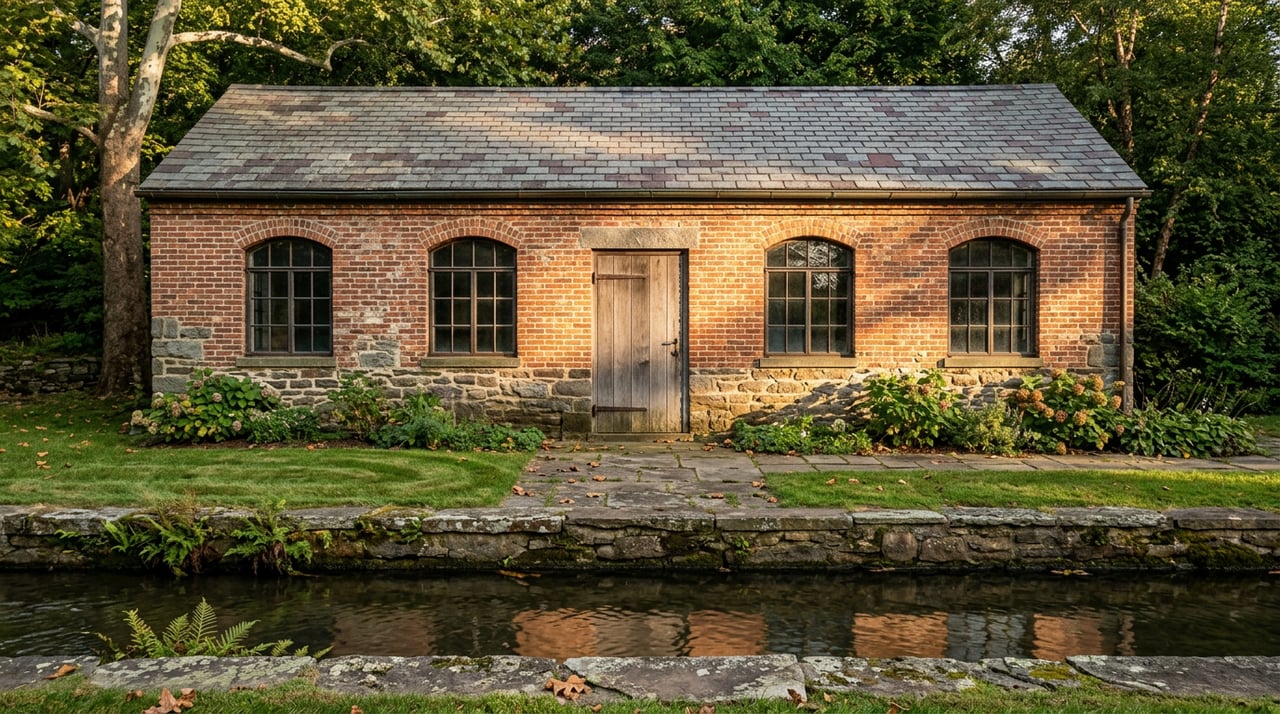
Walk down South Main Street this week and the marquee at 70 South Main still says what it said all August: RENT. Anthony Rapp and Adam Pascal's East Village of 1996 is filling a 1939 grist mill on the Delaware through September 13, and from the sidewalk nothing about the building looks different. That's the trick of a good handoff. The person who has run this theater for twelve years is gone. The person who picked this season isn't the person picking the next one. And the show on stage tonight was chosen by someone who already left the building.
That's the actual story of Bucks County Playhouse in 2026, and it isn't really about Rent, or Cat on a Hot Tin Roof, or any single title in the lineup. It's about the gap between a farewell season built by outgoing hands and the first season that will belong entirely to someone new.
A Season Built As A Goodbye
Producing Director Alexander Fraser, Executive Producer Robyn Goodman, and Producer Josh Fiedler announced in January that 2026 would be their last year at the Playhouse after joining together in 2014. Rather than coast out, they built what Fraser called the theater's "love letter" to the community that had backed it, a five-show mainstage lineup that also happens to land during the country's 250th anniversary.
| Production | Dates | Director |
|---|---|---|
| Starstruck (world premiere) | Feb. 19 – Mar. 21 | Lorin Latarro |
| Cat on a Hot Tin Roof | Apr. 23 – May 23 | Eric Rosen |
| South Pacific | Jun. 18 – Jul. 26 | Denis Jones |
| Rent | Aug. 13 – Sep. 13 | Jennifer Weber |
| Holiday Inn: The New Irving Berlin Musical | Nov. 19 – Jan. 3, 2027 | Hunter Foster |
Starstruck opened the year with a book by Beth Malone and Mary Ann Stratton and a score from Emily Saliers of the Indigo Girls, a new musical rather than a safe revival to kick off a farewell year. The choice tells you something about how this trio thought about their own exit: not a victory lap of familiar titles, but one more attempt to develop something nobody had seen before, threaded between the crowd-pleasers.
The Playhouse's Books in the Barn series runs in parallel with the mainstage season, pairing a discussion each production with a related book at the Barn next to the theater, done in partnership with the Doylestown and Lahaska Bookshops. The October slot, tied to a title still marked TBA on the schedule, is the first program decision that will land after the leadership change is fully in place.
What Twelve Years Actually Bought
Fraser arrived in New Hope in 2014, three years after Doylestown couple Kevin and Sherri Daugherty bought the Playhouse out of foreclosure and reopened it following a renovation. He recruited Goodman and Fiedler soon after. What they built over twelve years is measurable in a way most theater turnarounds aren't.
The organization's annual operating budget grew from $2 million to $12.1 million. Annual attendance climbed from just under 40,000 in 2014 to more than 85,000 in 2025, with subscriptions rising from 1,479 in 2015 to 3,303 in 2026. Average audience capacity moved from 34 percent to 64 percent, meaning a theater that once played to a third-full houses now regularly fills better than six seats out of ten. What had been a seasonal summer operation became a year-round producing company.
"I learned early on to leave while on top," Fraser said of the timing. "The theater is doing great and there's a great person coming in after me."
Numbers like these matter less as bragging rights than as the baseline the next producer inherits. Whoever runs a 64-percent-capacity, $12 million theater with 3,300 subscribers is starting from a different place than whoever ran a 34-percent house on a $2 million budget. The bar for what counts as success at the Playhouse has moved, permanently, whether the new leadership wants it to or not.
The Job Nobody Advertises For Twice
The Playhouse board hired Shruti Adhar of Management Consultants for the Arts to run a national search, with a committee that included board president Gayle Goodman, Mitch Berlin, Richard Henriques, Sherri Daugherty, and Lynn Breen. In March they landed on BT McNicholl, who spent the previous decade as producing artistic director of La Mirada Theatre for the Performing Arts in Los Angeles County, where he set all-time records for revenue, attendance, and subscriptions against the grain of national post-pandemic trends for regional theaters.
McNicholl's résumé also includes work as an associate director on twelve Broadway productions, among them Spamalot, Billy Elliot, and Cabaret, alongside directors Mike Nichols, Stephen Daldry, Sam Mendes, Jerry Zaks, and James Lapine. He officially stepped into the role on June 22, joining a leadership structure that didn't turn over with him. Executive Director Nicole Hackmann and Managing Director Teresa Sanpietro, who kept the organization running through the transition, stay in place. That continuity matters more than it sounds. The people who know where the pipes are, who the vendors are, and how the box office actually functions are the same people who were there in July.
Reporting from earlier this year quoted McNicholl describing the handoff as "part of the relay race," language that fits a theater built to keep momentum rather than reset it. Whether he means to run the same race or plot a new course is the question this season can't answer, because he didn't build it.
The Test Nobody's Watching For Yet
Here's the part that's easy to miss if you're only tracking what's currently on stage. The 2026 season, from Starstruck through Holiday Inn, was fully programmed by Fraser, Goodman, and Fiedler before any of them left. McNicholl inherited a lineup, not a blank slate. The real audition for what a McNicholl-era Playhouse looks like doesn't start until the 2027 mainstage announcement, whenever that lands.
That's the number worth watching, more than any box office figure from this farewell year. Does the next season lean further into new work the way Starstruck did, or pull back toward the reliable revivals that filled seats under the old regime? Does the subscriber base built up to 3,303 renew at the same rate under different artistic judgment, or does a change in taste at the top cost the theater some of the audience loyalty it spent a decade earning? Those answers won't show up until next year's playbill does.
Former Mayor Larry Keller, who served the borough for 27 years, has talked about how much New Hope changed once the Playhouse's turnaround took hold, and current Mayor Frank DeLuca has credited the theater's resurgence with helping drive the wave of restaurants and shops that filled in around Main Street over the past decade. That civic weight is exactly why a producer change here reads differently than the same news at a theater with less gravitational pull on its downtown. What happens on that stage has never stayed contained to the stage.
What's Actually Playing, And What Comes After
For now, Rent runs through September 13, with its Books in the Barn pairing scheduled for August 19. Holiday Inn: The New Irving Berlin Musical, directed by Hunter Foster, closes out the farewell season from November 19 through January 3, with its own Barn discussion set for December 2. Both are safe bets for anyone who wants to catch this trio's last programming decisions in person before the McNicholl era fully takes shape.
The theater at 70 South Main Street opened in 1939 inside a restored 18th-century grist mill, went dark and nearly lost its Actors' Equity status when its previous owner fell into debt around 2010, and came back to life only because the Daughertys bought it out of foreclosure the following year. It has been rebuilt once already. What's happening now isn't a rebuild. It's a relay, in McNicholl's own word, and the baton just changed hands mid-season, in front of an audience that's paying closer attention than the marquee lets on.
If you're weighing what a season of change at an anchor institution like this means for the character of the neighborhood around it, from Main Street's rhythm to the kind of buyer and seller these shifts tend to attract, Laurie Madaus has spent years reading exactly these signals in New Hope and the surrounding Delaware River Valley. Let's Connect.